A Jameson Dog product · Android
KeepText
Back up your text messages to a file on your phone.
KeepText copies the text messages on your phone into a single file, in a folder you can open in any file app. It can also read one of those files and put the messages back.
That is the whole product.
It has no internet permission
KeepText does not ask Android for permission to use the network. Without it, the operating system will not let the app open a connection — so your messages cannot be sent anywhere, by us or by anyone else, because there is no mechanism to send them.
You do not have to take that on trust:
- On your phone — Settings, then Apps, then KeepText, then Permissions. Look under “All permissions” for network or internet access. It is not there.
- On the Play listing — App permissions, then See more, will not show “full network access”.
- On the file itself — run
aapt2 dump permissionsagainst the APK.
There is no account, no sign-in, no cloud, no advertising and no analytics. Nothing is collected, because nothing can be.
Why we built it
We wanted this for ourselves: something small that did one job, asked for nothing, and could be checked rather than taken on faith.
We looked at what was already available, and kept finding the same thing: advertising, and a lot of screen between us and the file.
Backing up text messages is not, in itself, hard. It is a modest amount of code that reads your phone’s message store and writes a file. What usually makes software like this expensive is everything that gathers around that job — an account, a server to sync with, storage and bandwidth that grow with every person who installs it, and then the advertising or the subscription that has to pay for all of it. The running costs end up shaping the business model, and the business model ends up shaping the screen you look at.
Your messages stay on your phone, so none of that exists.
There is no server to run, nothing of yours to store, and no bandwidth to buy. Nothing recurring to fund means nothing that has to be monetised — which is why there is no advertising, no analytics, no account and no price. The privacy and the cost are not two decisions. They are the same one, made once, and everything else follows from it.
We think that is what this ought to look like. Keeping a copy of your own text messages is close to a basic part of owning a phone. It should not cost you money, or your attention, or a copy of your messages on somebody else’s computer.
So the app is quiet on purpose. One screen at a time, one thing on it, the file name and folder shown plainly at the end, and nothing anywhere asking you for anything. There is no upsell because there is nothing to sell.
What it looks like
Seven screens from the app, unretouched.
-
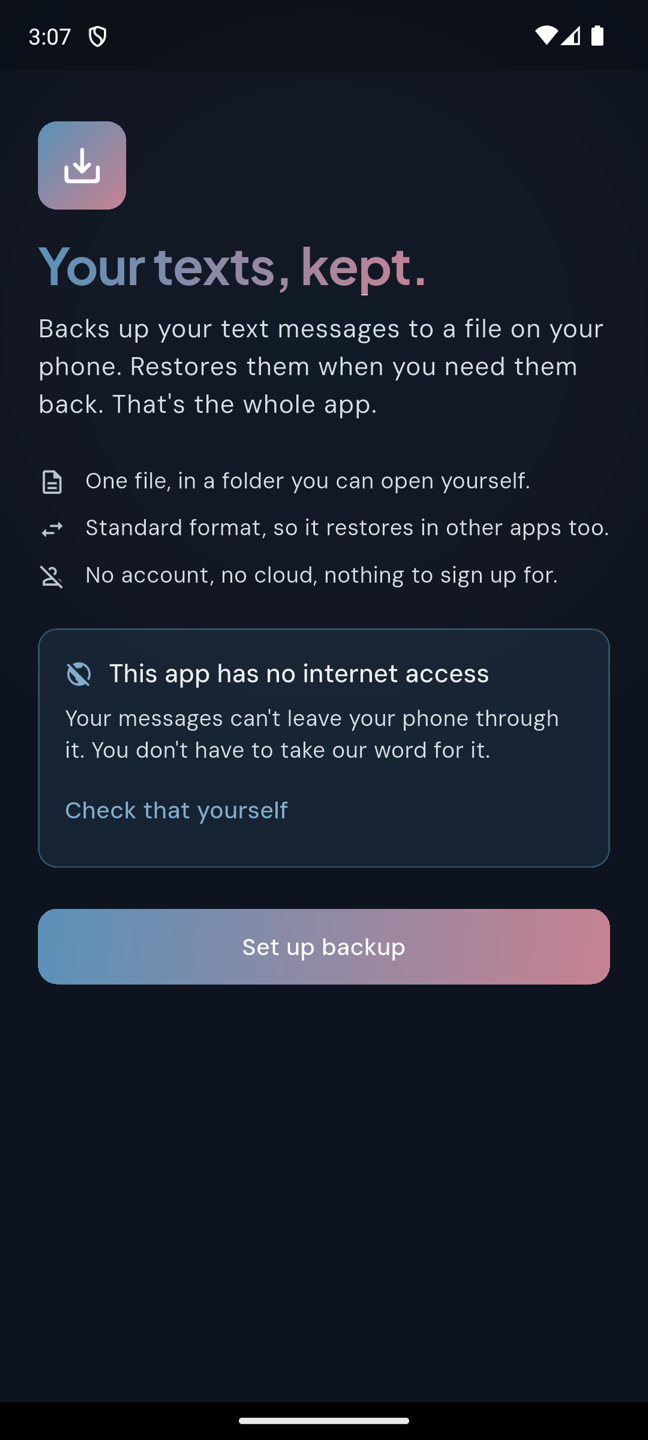
The first screen, before anything is asked
-
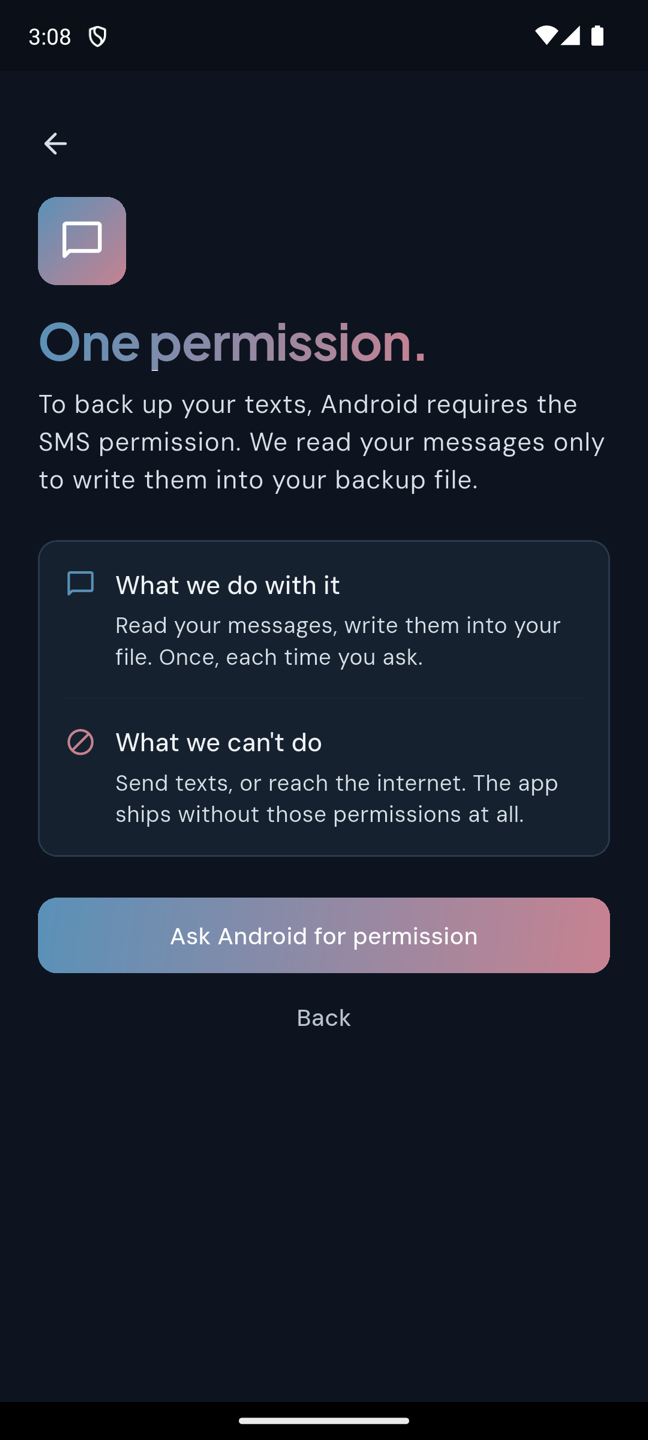
Every permission gets a screen of its own first
-
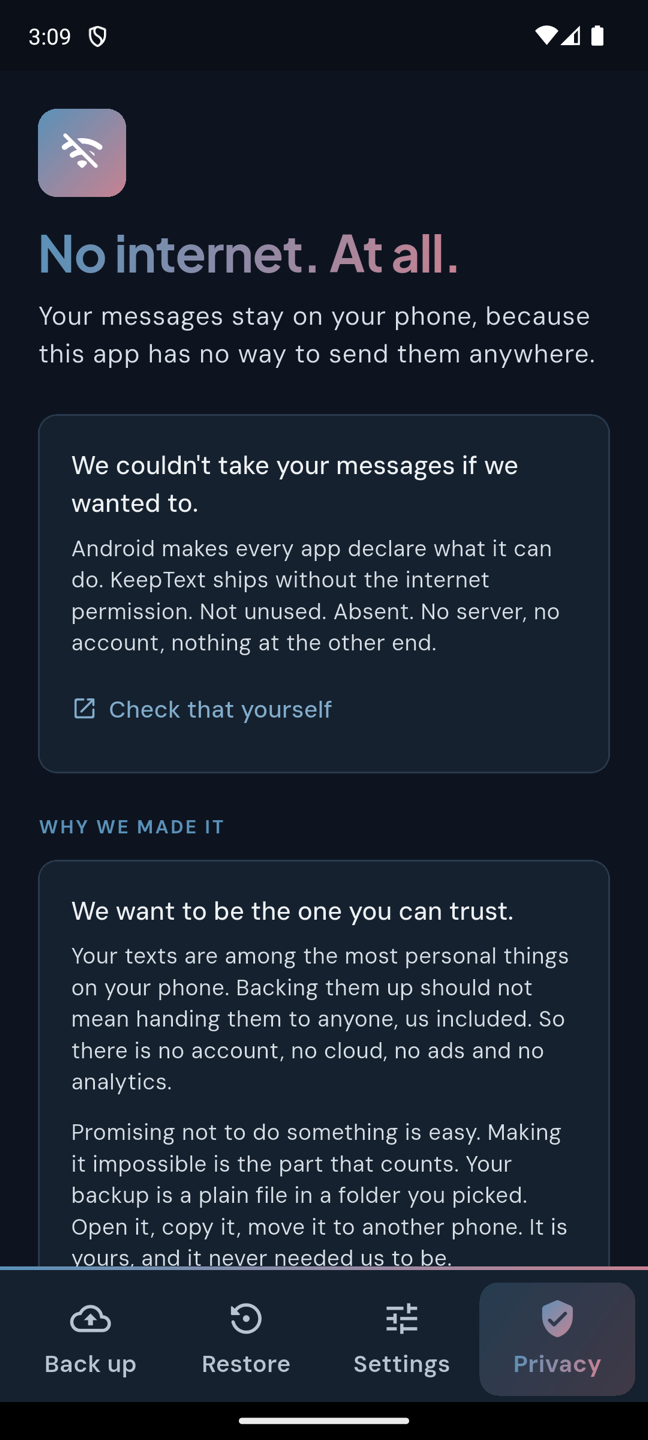
The claim, and where to check it
-
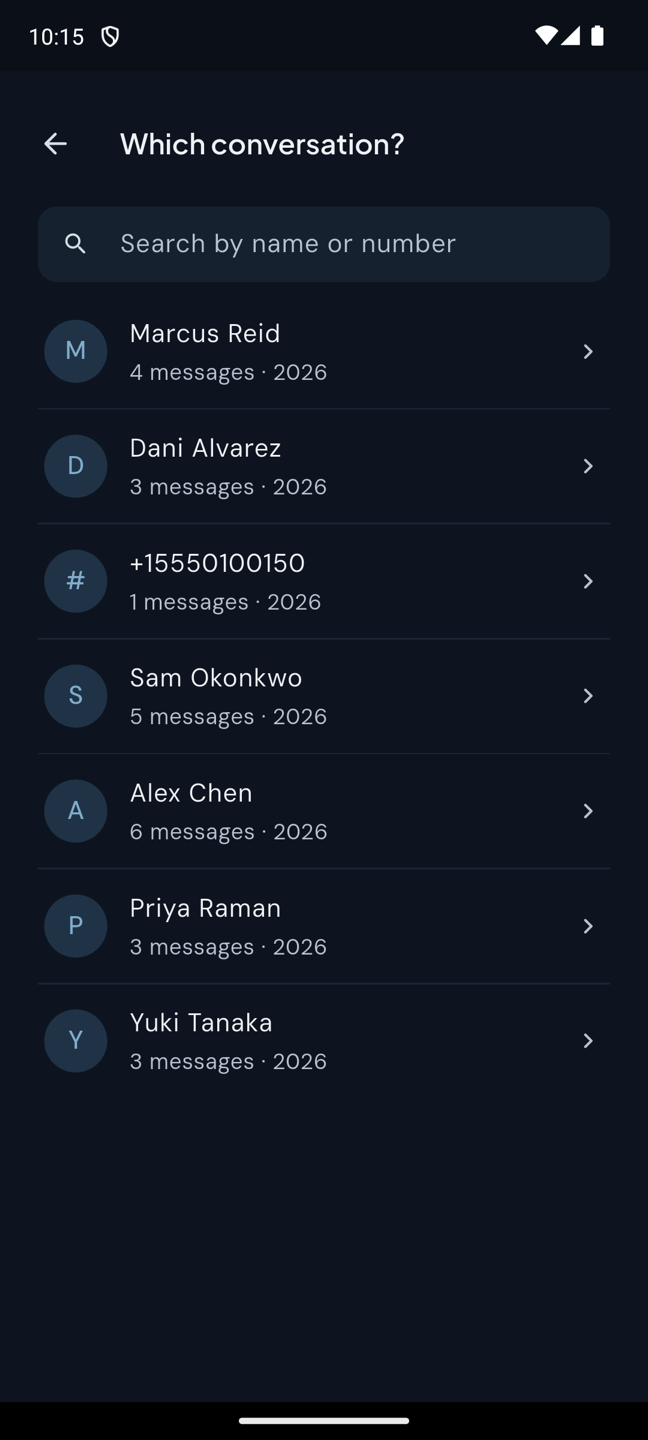
The whole phone, or one conversation
-
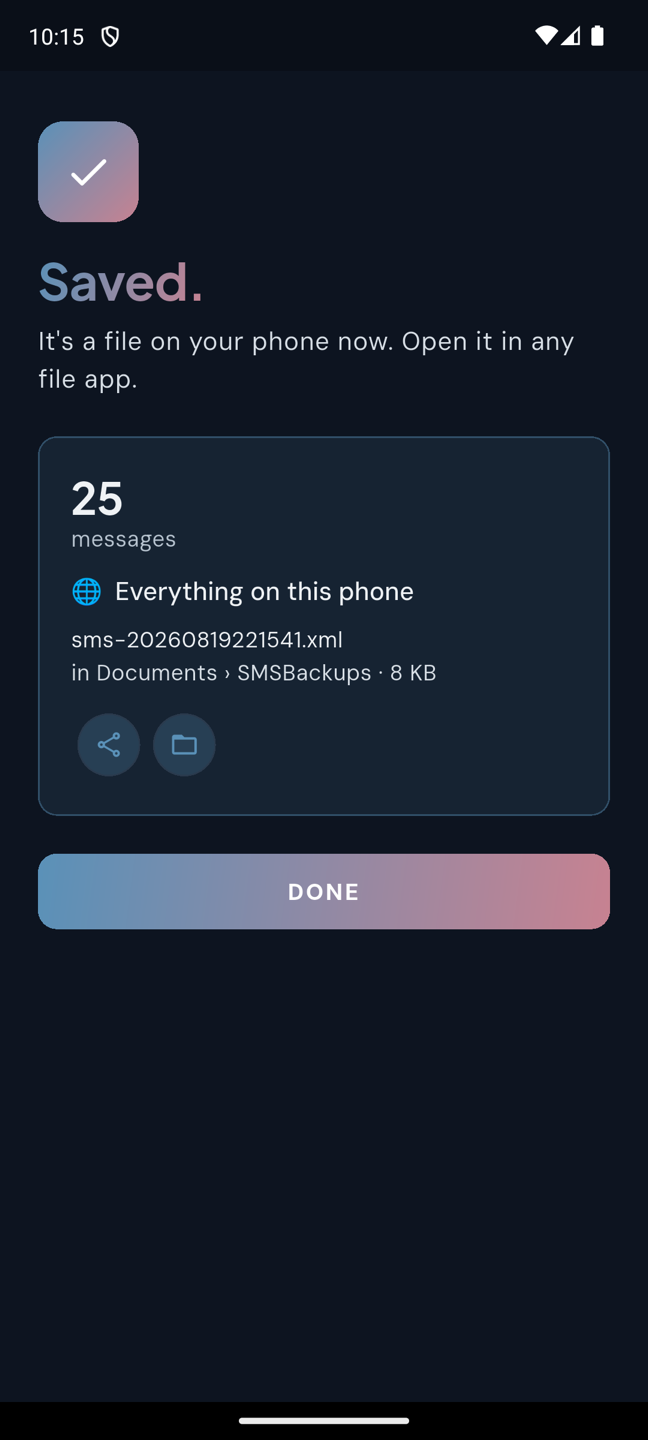
The name, the folder and the count
-
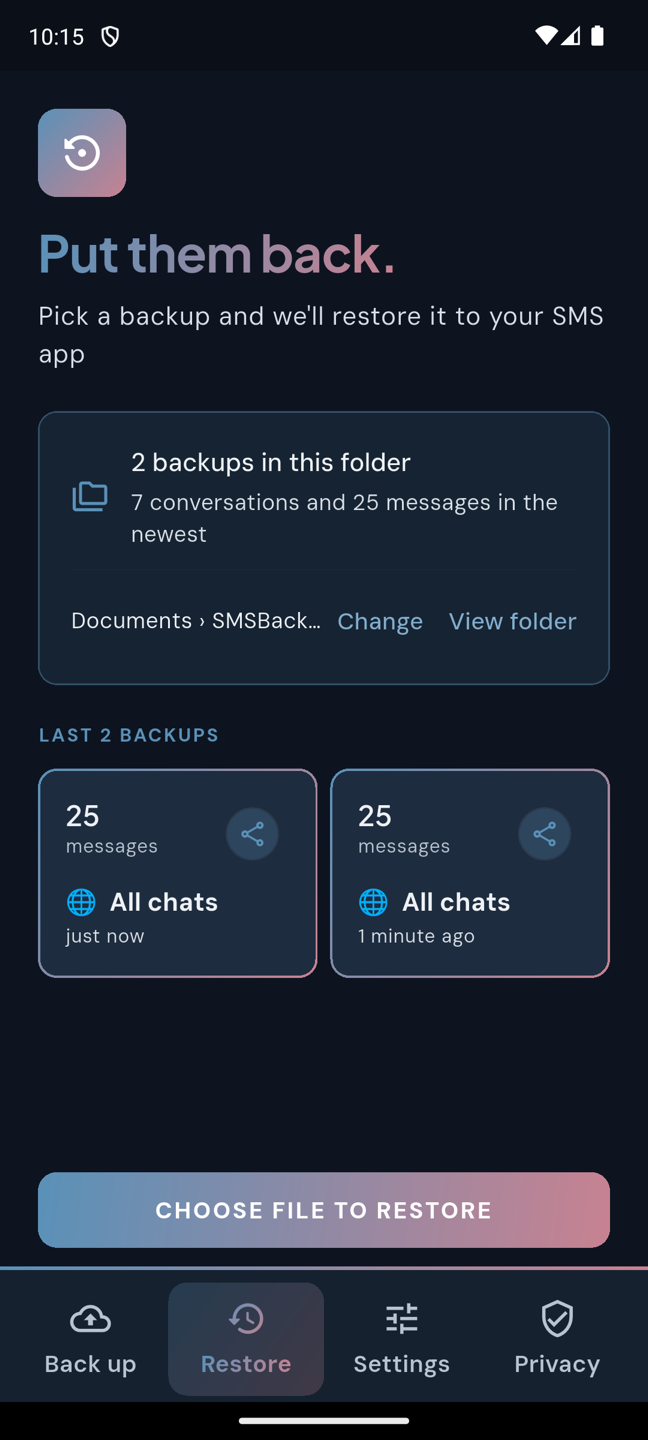
What is already in your folder
-
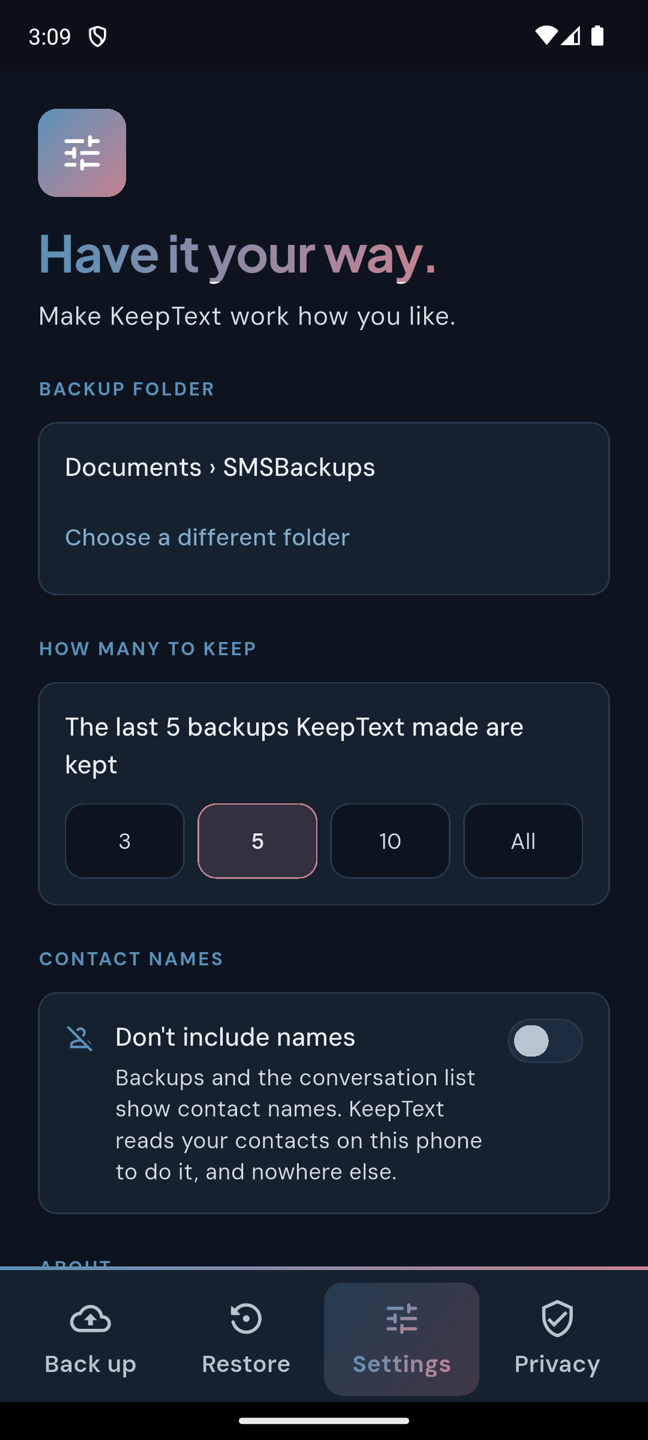
Three settings, because there are three
Your file, in a normal folder
Backups go to Documents/SMSBackups. When one finishes, the app
shows you the file name, the folder and how many messages it wrote — so
you can find your own file afterwards without opening the app again.
The format is the widely used XML one that other message-backup tools read and write, so your file is not locked to this app. A backup you can only restore with the tool that made it is not much of a backup.
Restoring
Android only allows the default messaging app to write to your messages. So a restore asks to hold that role for as long as the job takes, then asks you to hand it straight back — and reminds you until you do. Restoring the same file twice does not duplicate anything.
Worth knowing before you rely on it
- This version backs up SMS text messages only. Picture messages and group threads sent as MMS are not included yet.
- Messages your messaging app has sent as RCS are stored separately by that app and are not part of your phone’s SMS store, so they are not in the backup. In a messaging app the two look identical, which makes this easy to be surprised by.
- Sharing a backup file sends it wherever you choose, and a backup file contains your messages in readable form.
- The backup file is not encrypted. It lives in a normal folder so you can get at it, which also means anything with storage access can. Your phone’s lock screen and encryption are what protect it.